Tuition fees, visa requirements, and university-specific details are subject to change. Prospective students are advised to verify all information through official university channels and relevant embassy resources. EduHealth Bridge provides guidance based on the most current available information at the time of consultation.
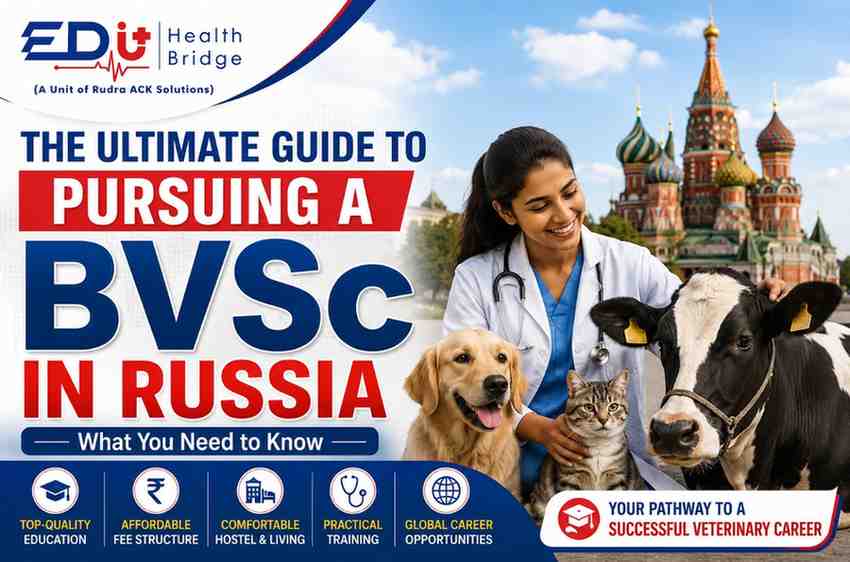
BVSc in Russia has steadily emerged as one of the most sought-after destinations for students aspiring to pursue a Bachelor of Veterinary Science (BVSc) degree. With world-renowned universities, affordable tuition fees, globally recognised qualifications, and a rich tradition of scientific excellence, Russia presents an exceptional opportunity for international students from South Asia, the Middle East, Africa, and Southeast Asia. At EduHealth Bridge, we have guided hundreds of students through this journey, and this guide consolidates everything you need to know.
|
|
WHY CHOOSE RUSSIA FOR A BVSC DEGREE? |
The BVSc in Russia decision to study veterinary science abroad involves careful evaluation of academic quality, financial investment, career outcomes, and personal adaptability. Russia checks all the right boxes for students serious about building a rewarding career in veterinary medicine.
Russian universities have been at the forefront of veterinary and agricultural sciences for over a century. Many are recognised by the World Organisation for Animal Health (WOAH), which significantly enhances the global portability of the degree. Tuition fees range between USD 3,000 and USD 6,000 per academic year — a fraction of comparable programmes in the UK, Australia, or the United States.
|
|
OVERVIEW OF THE BVSC PROGRAMME |
The BVSc in Russia is a five-and-a-half to six-year undergraduate professional degree that prepares students for careers in animal health, food safety, research, and public health. Below is the curriculum structure:
|
Duration |
Phase |
Key Subjects |
|
Years 1–2 |
Preclinical Sciences |
Anatomy, Histology, Biochemistry, Physiology, General Biology |
|
Years 2–3 |
Paraclinical Sciences |
Microbiology, Parasitology, Pathology, Pharmacology, Immunology |
|
Years 3–6 |
Clinical Sciences |
Surgery, Internal Medicine, Obstetrics, Epizootiology, Food Hygiene, Vet. Jurisprudence |
The medium of instruction is primarily Russian. However, several universities in the EduHealth Bridge partner network offer programmes partially or fully in English, along with a structured Russian language preparatory year
|
|
TOP RUSSIAN UNIVERSITIES OFFERING BVSC |
Russia is home to several prestigious institutions with dedicated veterinary faculties. Here is a comparative overview of BVSc in Russia:
|
University |
City |
Key Strengths |
|
Moscow State Acad. of Vet. Medicine (MVM) |
Moscow |
Oldest & most distinguished; large animal hospital |
|
St. Petersburg State Acad. of Vet. Medicine |
St. Petersburg |
Strong clinical training; near top research institutes |
|
Kazan State Acad. of Vet. Medicine (Bauman) |
Kazan, Tatarstan |
Popular with intl. students; lower cost of living |
|
Ural State Agrarian University (UrSAU) |
Yekaterinburg |
Strong livestock medicine & agricultural integration |
|
Don State Technical University (DSTU) |
Rostov-on-Don |
Modern infrastructure; active intl. student programmes |
EduHealth Bridge works directly with the admissions departments of all partner universities, ensuring every applicant receives personalised guidance and a smooth enrolment experience.
|
|
ELIGIBILITY & ADMISSION REQUIREMENTS |
● Academic Qualifications — Completed Class 12 / HSC with Biology, Chemistry, and Physics or Mathematics. Minimum 50% aggregate required.
● Age Requirement — Applicants must be at least 17 years of age at the time of enrolment BVSc in Russia.
● Language Proficiency — Basic English for English-medium programmes. Russian language courses are provided during the preparatory year.
● Entrance Examinations — Generally not required. Admission is merit-based on secondary school grades.
EduHealth Bridge provides a complete pre-application review service to ensure all documents — transcripts, identity documents, medical certificates, and photographs — are correctly prepared and submitted on time.
|
|
THE APPLICATION & VISA PROCESS |
|
1 |
University Selection & Application Working with EduHealth Bridge, students select the most suitable university based on academic profile, budget, and location. An official application is submitted. |
|
2 |
Invitation Letter Upon acceptance, the university issues an official Invitation Letter — a critical document required for the Russian student visa application. |
|
3 |
Visa Application (Type D National Visa) Submit the Invitation Letter, valid passport, visa form, photos, medical certificate (including HIV test), and proof of financial means to the Russian Embassy. Processing: 2–4 weeks. |
|
4 |
Arrival & Registration Students must register with GUVM MВД within 3 working days. EduHealth Bridge coordinates with university housing to ensure timely and correct registration. |
|
|
TUITION FEES, SCHOLARSHIPS & LIVING COSTS |
Russia offers one of the world's most cost-effective higher education systems. Here is a realistic financial overview BVSc in Russia:
|
Expense Category |
Annual (USD) |
Monthly (USD) |
|
Tuition Fees |
3,000 – 6,000 |
— |
|
University Hostel |
300 – 600 |
25 – 50 |
|
Food & Groceries |
— |
100 – 180 |
|
Transport & Utilities |
— |
50 – 80 |
|
Personal & Misc |
— |
50 – 100 |
|
Total (Approx.) |
3,600 – 7,400 |
225 – 410 |
Russia also offers government scholarships via Rossotrudnichestvo (Federal Agency for CIS Affairs), which covers tuition and provides a monthly stipend. EduHealth Bridge assists eligible students in identifying and applying for all available scholarship opportunities BVSc in Russia.
|
|
CAREER PROSPECTS AFTER BVSC FROM RUSSIA |
● Clinical Practice — Work in small/large animal clinics, equine centres, zoos, or wildlife facilities domestically or internationally.
● Food Safety & Public Health — Roles in public health departments, food regulatory agencies, FAO, WHO, and international veterinary bodies.
● Research & Academia — Pursue postgraduate studies (Candidate of Science / Doctorate) in veterinary research or pharmaceutical settings.
● Government & Regulatory Services — Border inspection, quarantine services, disease surveillance, and livestock regulatory bodies.
Students planning to practise in their home country should verify national licensing requirements. EduHealth Bridge provides dedicated counselling on licensing examinations and equivalency procedures.
|
|
LIFE AS AN INTERNATIONAL STUDENT IN RUSSIA |
Major student cities such as Kazan, Rostov-on-Don, and Voronezh have well-established international student communities. University campuses are equipped with hostels, canteens, sports facilities, and student support services BVSc in Russia.
Winters in Russia require preparation — students from tropical climates should invest in proper winter clothing. Healthcare for registered students is provided through university medical centres, with well-equipped hospitals accessible in all student cities.
|
|
WHY EDUHEALTH BRIDGE IS YOUR IDEAL PARTNER |
At EduHealth Bridge, we believe every aspiring veterinarian deserves a clear, honest, and supportive pathway to their chosen career. Our end-to-end services include BVSc in Russia:
● Eligibility Assessment — Personalised evaluation of your academic profile and university options.
● Document Preparation — Complete assistance with transcripts, certificates, and visa documentation.
● Visa & Travel Guidance — Step-by-step support from visa application to pre-departure orientation.
● On-Ground Support — Local representatives in Russia to assist with registration, housing, and settling in.
Our track record of successful enrolments, combined with our commitment to transparency and ethical guidance, makes EduHealth Bridge the most trusted name in veterinary education consultancy for students aspiring to study in Russia.
|
READY TO START YOUR BVSC JOURNEY? Contact EduHealth Bridge today for a FREE consultation with our veterinary education specialists. |